
The AI Disruption Sell-Off: What Happened, What It Means, and What to Watch Next
Date: February 5, 2026
Executive Summary
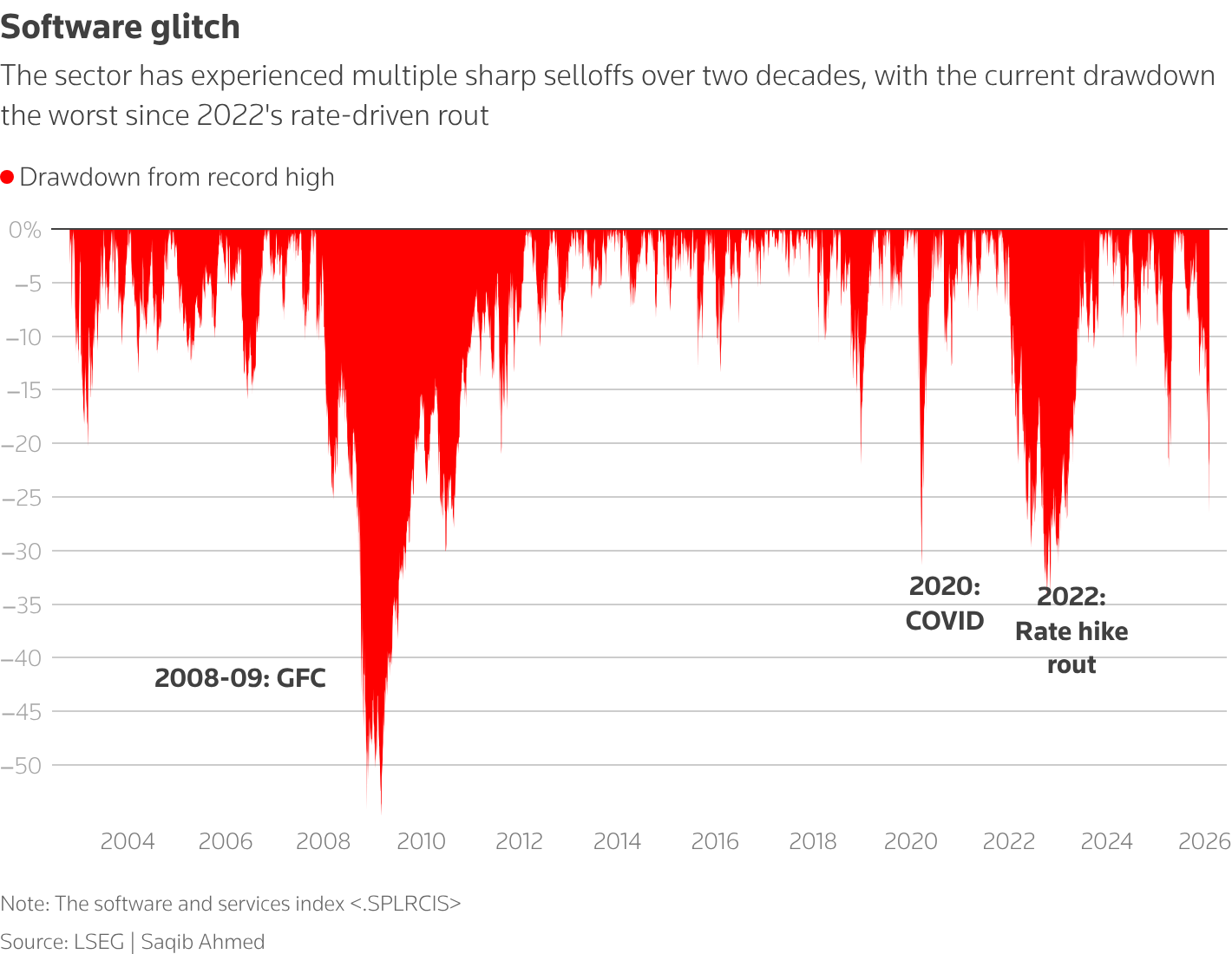
- A rapid sell-off swept through software and AI-linked stocks after Anthropic’s legal-task automation tool revived fears that foundational AI could cannibalize traditional SaaS models.
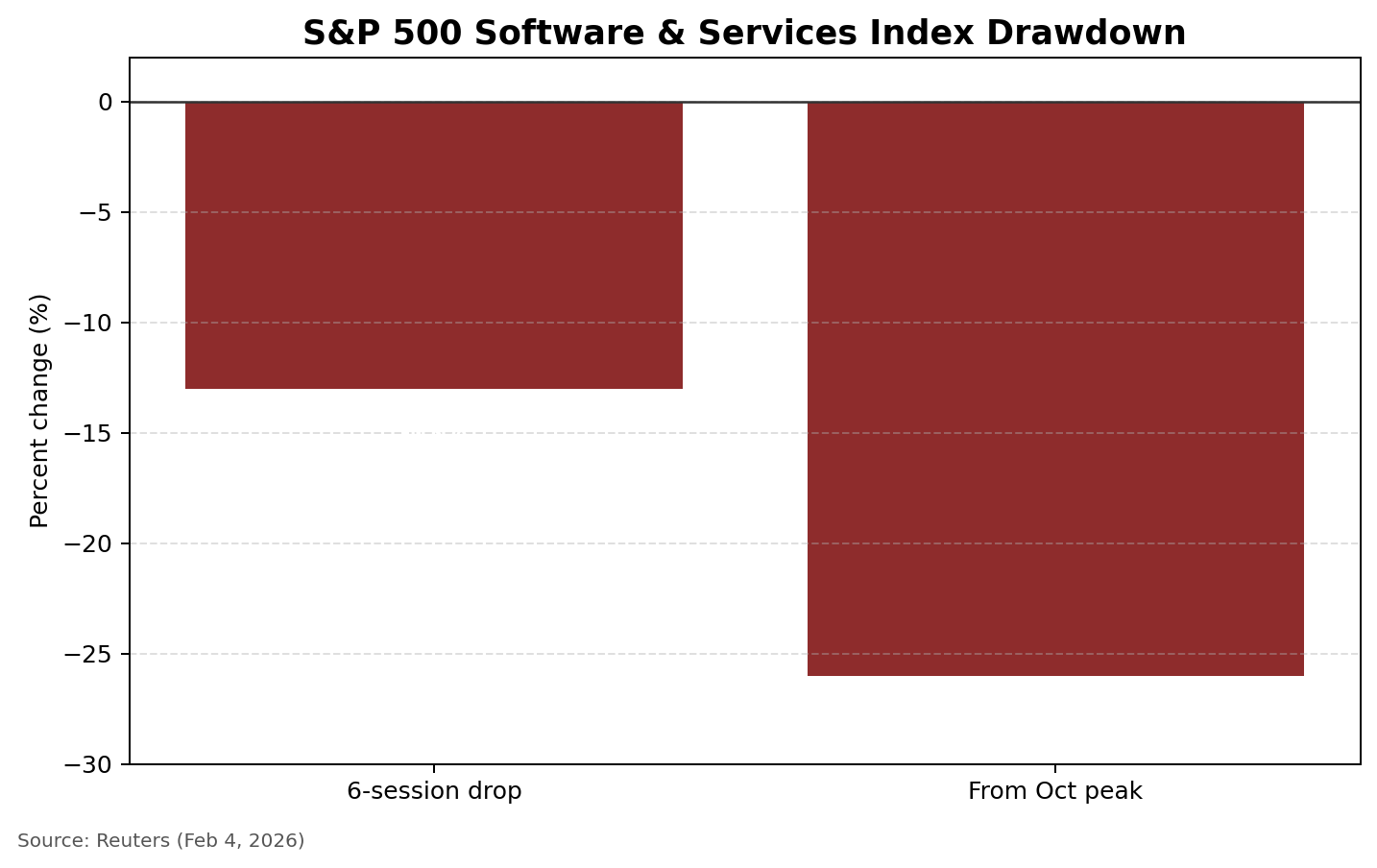
- The S&P 500 Software & Services Index fell nearly 13% over six sessions and is down about 26% from its October peak, erasing roughly $830 billion in market value in under two weeks.
- The sell-off broadened beyond software into semiconductors and asset managers, as investors reassessed AI monetization timelines, valuation multiples, and competitive moats.
1) The spark: a new AI tool, and an old valuation question
The immediate catalyst was Anthropic’s release of a legal-work automation tool that pushed large language models further into the “application layer.” Investors quickly connected the dots: if AI can draft, review, and reason through complex legal workflows, then other high-margin software segments could be next.
That narrative shift matters because much of software’s premium valuation rests on two assumptions:
- sticky, mission-critical workflows; and
- predictable, recurring revenue over multi‑year horizons.
When AI suddenly looks like it might compress the value of those workflows, valuations re-rate quickly.
2) Why software is in the crosshairs
Software companies have long benefited from high gross margins and pricing power. But AI-driven automation threatens to:
- Unbundle workflows by replacing multi-step enterprise software stacks with AI agents;
- Compress pricing if AI can deliver similar outcomes at lower marginal cost; and
- Erode switching costs as AI abstracts away vendor-specific UI and functionality.
This is why the sell-off centered on software and data services — and why it felt different from prior “AI hype” pullbacks.
3) The drawdown by the numbers
The move wasn’t subtle. By February 4, 2026:
- The S&P 500 Software & Services Index was down nearly 13% over six sessions and 26% from its October peak.
- The sector shed an estimated $830 billion in market value since January 28.
4) Spillover into semiconductors and mega-cap tech
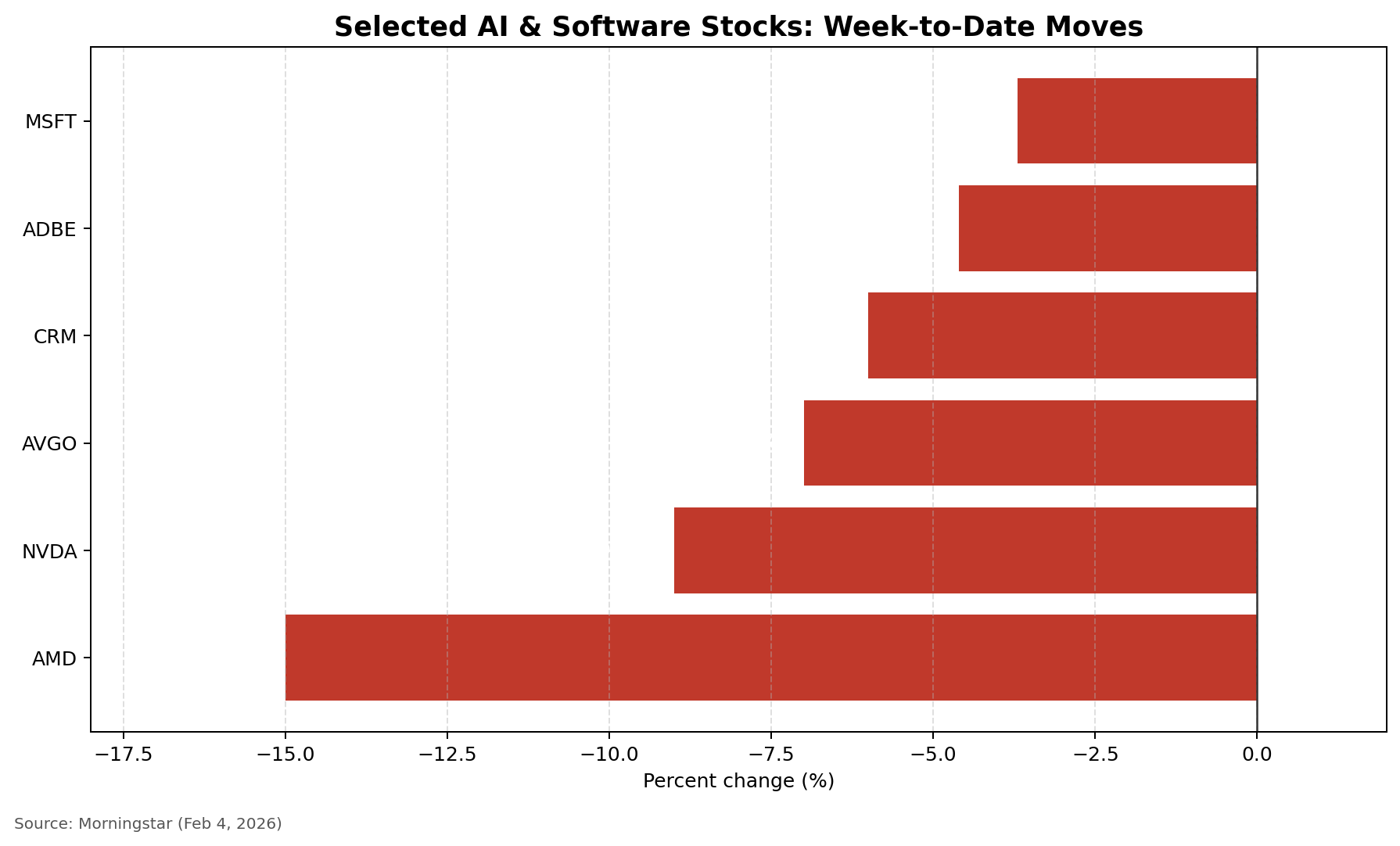
The sell-off spread into AI infrastructure names as investors re-priced the “AI ROI timeline.” Several large-cap tech names posted sharp weekly declines, and chipmakers faced their own guidance‑driven selling.
5) Two competing narratives
Bear case: AI disrupts the software stack faster than revenue can adapt
If AI agents replace or commoditize enterprise software workflows, the “application layer” could see margin pressure and lower retention. Even firms that embed AI into their products may face price compression and faster competitive cycles.
Bull case: AI expands the pie and strengthens top platforms
The counter-argument is that better AI makes software more powerful and more valuable. In this view, AI is a productivity amplifier, not a replacement—and the best platforms will capture more usage and larger budgets.
6) What investors should watch next
Near‑term indicators
- Enterprise software pricing power (renewal rates, seat growth, expansion).
- Evidence of AI cannibalization vs. AI-led upsell.
- Capex intensity at hyperscalers and AI labs relative to revenue growth.
Medium‑term indicators
- Which verticals are most exposed to automation (legal, finance, compliance, analytics).
- Emergence of AI-native challengers with direct-to-enterprise distribution.
- Regulatory and IP decisions that could accelerate or slow AI adoption.
7) Bottom line
The sell-off was a rapid repricing of uncertainty, not a definitive verdict on AI’s winners and losers. Whether it proves an overreaction or the first step of a deeper rotation will depend on whether AI becomes a layer inside existing products—or a replacement for them.
For investors, the key is to separate AI-driven volatility from AI-driven fundamentals. The next earnings season will likely determine which path the market chooses.
Sources
- Reuters (Feb 4, 2026): https://www.reuters.com/business/media-telecom/global-software-stocks-hit-by-anthropic-wake-up-call-ai-disruption-2026-02-04/
- Wall Street Journal Opinion (Feb 4, 2026): https://www.wsj.com/opinion/ai-stock-market-software-companies-selloff-02bef5d0
- Morningstar (Feb 4, 2026): https://www.morningstar.com/markets/what-know-about-software-stock-selloff